
BEV or PHEV – it actually may not matter
Five years ago, plug in hybrids (PHEVs) were seen as a stepping stone to battery electric vehicles (BEVs). With slower uptake of BEVs than expected, PHEVs look set to be around for a long time to come. That would suggest that CO2 emissions will be higher than in a BEV-only world, but is that actually true?
To calculate EV emissions, we have to calculate the CO2 involved in making the battery, and then the CO2 emitted by the generation of the electricity to charge it.
CO2 from manufacturing the battery pack
MIT (Massachusetts Institute of Technology) calculates that manufacturing the average battery pack is responsible for 115kg of CO2 per kWh – so manufacturing a 60kWh BEV battery pack, for something like a VW ID3, emits 6.9 tonnes of CO2. Incidentally, Polestar puts the average CO2 for manufacturing that battery at 6.6 tonnes, so a pretty similar figure.
For a PHEV, the battery pack is smaller – 20kWh is becoming a benchmark figure. So manufacturing the PHEV battery pack is responsible for 2.3 tonnes of CO2.
CO2 from EV usage – recharging the battery
UK grid carbon intensity is 170g of CO2/kWh so, assuming a vehicle lifetime of 200,000km (124,000 miles) at 6.4km (4 miles) per kWh, the BEV is responsible for a further 5.3 tonnes of CO2 (0.00017t x (200,000km/6.4)).
For the PHEV, the calculation is a bit more complicated, as we have to assume the proportion of mileage which will be done on batteries. A 20kWh battery gives a range of 80 miles (4 miles per kWh) for an average car, so most journeys can be made on battery alone. Assuming the owner can and will plug in regularly, 80% mileage on battery is achievable, meaning 40,000 km (24,000 miles) will be done on petrol. At 45 mpg (which equates to 150g of CO2/km), the PHEV will emit 6.0 tonnes of tailpipe CO2 (0.00015t x40,000km).
In addition it will be responsible for CO2 from recharging the 20kWh battery pack. Assuming 160,000 km (100,000 miles), that figure will be 4.25 tonnes.
Putting the figures together
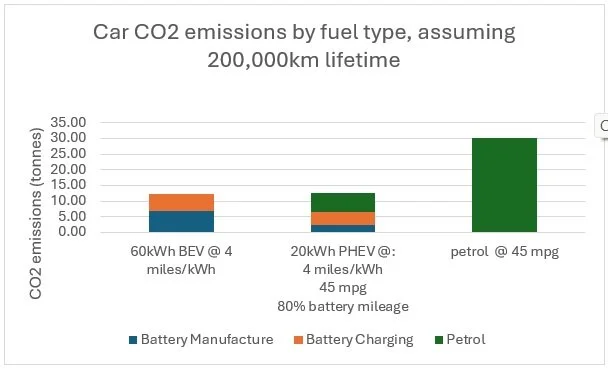
The BEV is responsible for 12.2 tonnes of CO2 (6.9 tonnes from manufacturing plus 5.3 tonnes from recharging the battery).
The PHEV is responsible for 12.55 tonnes (2.3 tonnes from manufacturing plus 4.25 tonnes from recharging the battery and 6.0 tonnes from petrol emissions).
To put those figures into context, a pure petrol car at 45 mpg emits 30 tonnes of CO2 (150g of CO2 per km x 200,000km).
The figures show that, today, PHEVs can be as low in CO2 as BEVs if the owner has a modest daily commute and has the ability and motivation to charge them as often as possible. Over time, the UK grid will decarbonise, so the advantage will move towards BEVs. However, right now, using a PHEV in its intended way can be just as good as BEV for CO2 – and is far better than petrol. Just be prepared to use that charging cable: a PHEV that is never plugged in has the highest CO2 emissions of all.