
SDV – the most important tech you’ll never see
A recent column by the excellent Matt Prior in Autocar raised the question of whether “Software Defined Vehicles” (SDV) is much more than the latest automotive buzz-phrase. So let’s try and establish what SDV means, and whether, beyond the imagination of marketing departments, it really is significant.
Phase 1 of SDV means taking the computing power away from individual components and giving it to central processors. You might wonder how much intelligence a component has, but almost everything now has a processor – there are 100-150 of them dotted around a modern car. Their number has multiplied as carmakers seek greater efficiency and more features – 30 years ago, the brain needed to regulate the wipers was the one in the driver’s head, but rain-sensing wipers need their own processors.
A car with a few powerful central processors and an operating system can save costs by eliminating those distributed processors. It also means the car is quicker to develop, and can be upgraded during use via Over The Air (OTA) updates, as only the software in central processors has to be updated. However, changing to SDV is a fiendishly complex task: a modern car has over 100 million lines of code, and they are almost all going to be impacted by a move to SDV.
Phase 1 gives a big benefit, but it still leaves, literally, kilometres of point-to-point wiring between central processors and components. Hence the need for Phase 2 – something called “zonal architecture”.
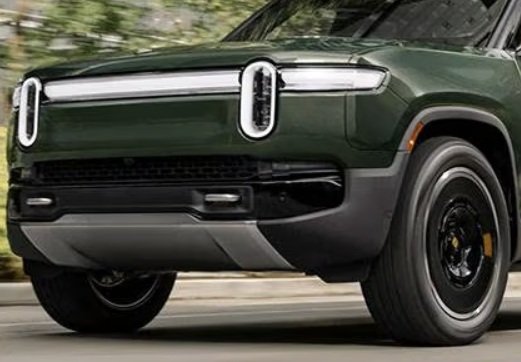
Zonal architecture means scrapping the traditional approach of dividing car electronics by function (lighting, braking etc), and dividing it instead by location (front right corner, front left corner etc.). All the electronics in that zone communicate with a zonal controller, and all zonal controllers communicate with a central processor. This can eliminate a huge amount of wiring, which is replaced by automotive-specific ethernet cabling, designed to enable multiple applications (e.g. headlights and indicators) to share the same wires. Recently, Rivian updated the R1S with a new electronic architecture which cut to number of ECUs to just seven and managed to remove 2.5 km and 20kg of wiring – and that was on a vehicle that already had one of the most advanced electronic architectures (hence why VW is investing up to $5.8bn in Rivian).
Are there any cars that are fully SDV today? That is debatable. An analysis by S&P Mobility reckons the most advanced models are getting close. This includes the Tesla Model 3 (despite all Elon’s ever more fanciful talk about autonomy, Tesla’s real technological advantage is its pioneering electronics).
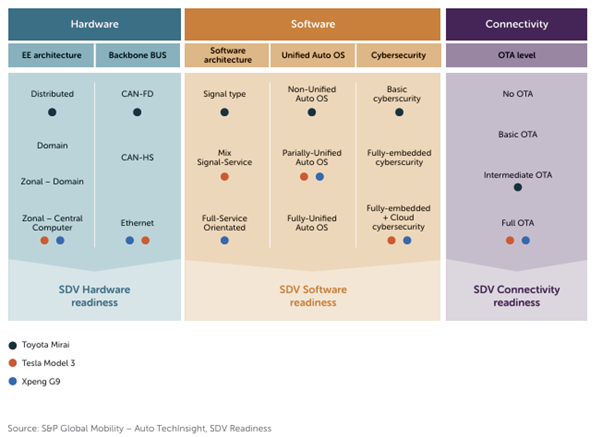
SDV adoption
The UK’s Advanced Propulsion Centre (APC), which funds automotive R&D agrees, but said in a 2025 report, “there is no full SDV on the road today because no vehicle has a fully-unified auto-operating system (OS).” Both the APC and McKinsey think SDVs will emerge progressively, becoming the standard around the mid-2030s.
As to the question, “What is SDV for?” it is an enabling technology. It won’t make the car drive better by itself, but it makes modern cars simpler to design, cheaper to build and easier to improve. Enabling technologies often seem pointless when they are first introduced – when Faraday demonstrated electricity to Queen Victoria, she is reported to have asked, “What good is it?”. It is a racing certainty that SDV will spawn products and features that we have not yet thought of. How many will be genuinely useful and how many will fall into the category of “Because we can” is a different question.